There’s a scene from my favorite movie, Amelie, where she’s standing in a quaint little French street in front of a grocer. She pauses beside the produce stand and when no one’s paying any attention, she slowly sinks her hand into a bag of lentils. She closes her eyes as an expression of peace and delight washes over her face. In the midst of the streetscape bustle Amelie experiences calm and a temporary escape through this simple, tactile act.
Just like Amelie, my girls are enjoying the feeling and pressure of swirling their hands and arms in a bucket of grain.
As far as the senses go, touch is fundamental to understanding our surroundings and the activities of everyday life. Our largest organ, our skin, is responsible for much of our tactile experiences. Our skin is constantly receiving messages about our environment and communicating those messages to our brain to interpret the experience…and how we need to react to that experience. We’re alerted to danger (when our hand touches a hot stove burner, we quickly pull our hand away!). We feel comfort, calm, and safety (curled on the couch wrapped in a warm, fuzzy blanket…all is well and I can rest).
The greater the variety of tactile experience during childhood, the greater the understanding the child will develop about their environment and more successfully they navigate that environment. Exploring touch is essential for all children, especially those with visual impairments. Whether you have a big yard or a modest apartment balcony, you can easily maximize the tactile quality of your space for your kiddos. How do you do that? Look around you right now. What do you see in various textures? Where and how do you experience warmth, coolness, cold? To add more tactile interest, think temperature and texture. How many ways can kids explore tactile qualities like:
Soft . Fuzzy . Smooth . Hard . Bumpy .
Prickly . Warm . Cool . Cold . Icy .
What else??
If you have kiddos that are hypersensitive or hyposensitive to touch, a space filled with a variety of textures and temperatures will help them explore this sensory system on their own terms and at their own pace which will help bring them self-regulate their nervous system.

Make an easy nature loom out of a garden obelisk, trellis, or fencing.
Give them what they love! Be sure to include lots and lots of the textures they love so their time is as joy-filled as possible. Here are some ideas for adding tactile interest to their play and learning space:
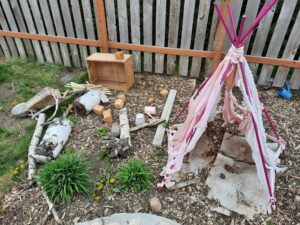
A loose parts play area can look messy at times but that’s ok. The sensory value is off the charts amazing!
Nature is always inviting children to play and connect. Children always want to be hands-on in that experience.
Sensory plants that invite touch are incredible assets in a nature play space. Consider them ambassadors for co-creating children’s nature appreciation and connection.
Through touch, children get to know each plant intimately, and through that process become part of the magic and awe of nature.
Let me say it directly: Children come to know they’re part of nature.
When we slow down and pay attention we really notice the incredible variety of textural interests in the plants and trees around us: the bark, branches, leaves, cones, flowers, seed heads, and pods.
It’s pretty mind boggling.
So, how can you use plants to boost the play and learning value?
Can you use plants to create textural contrast? How about planting purple coneflower next to lamb’s ears? Running your fingers over the spiny seedheads of coneflower are a distinctly different experience than stroking the fleecy, fuzzy leaves of lamb’s ears. There are so many ways to mix-and-match plant textures.
How can tactile plants be used in play activities? Natural loose parts play is a great place to start. I have another post about the play value of loose parts.
Lastly, tactile plants are very effective when planted where children spend lengths of time in an activity, like a sand play area, cozy space, or fairy garden. Plants within arms reach will be reached for, again and again.
Some of my favorite plants for tactile interest include:
Big Ears Lambs Ears, Stachys byzantina ‘Big Ears’, hardiness zones 4-9
This perennial tops my list of tactile favorites! The leaves of lambs ears feels just as soft and fleecy as the name sounds. I much prefer the Big Ears variety (also called Helen von Stein) as it doesn’t spread as enthusiastically as other varieties. This plant is a tagless cotton shirt, if you catch my drift. If you have a kiddo who’s touch averse, this plant offers great potential for exploring that comfort zone.
Approx. 12” tall x 24” wide and spreading
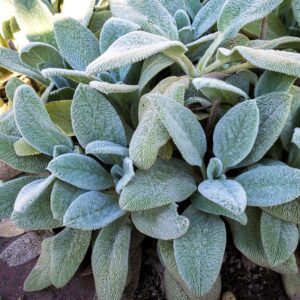
Big Ears Lambs Ears is my all-time fave tactile perennial.
Kim’s Knee High Coneflower, Echinacea purpurea ‘Kim’s Knee High’, hardiness zones 3-8
Coneflowers have a spiny seedhead that it’s really interesting to touch. Don’t prune off the seedheads in the fall. Leave them over the winter for loose parts play and food for birds.
18” tall and wide
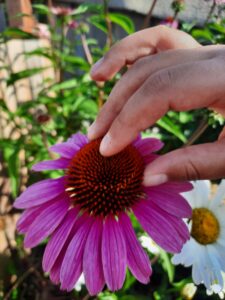
Kim’s Knee High and other coneflower varieties have an interesting seedhead and the pollinators love them!
Woolly Thyme, Thymus pseudolanuginosus, hardiness zones 4-7
Kids can walk barefoot on woolly thyme. As winter makes way to spring, forsythia’s blooms are like radiant sunshine. This early bloomer brings cheer to any early garden. The flowers are also edible and can be used salads or made into jelly, syrup, and tea!
4”-6” tall x 12” wide
Purple Emperor Sedum, Sedum x ‘Purple Emperor’, hardiness zones 3-9
This full sun, drought tolerant perennial is a great tactile plant for its succulent, spongy leaves and its fluffy summertime flower heads. Keep the flower heads on through the winter for four seasons of play value.
12” tall x 18” wide
Little Bunny Dwarf Fountain Grass, Pennisetum alopecuroides ‘Little Bunny’, hardiness zones 4-9
Fountain grass comes in all sizes and Little Bunny is the smallest of them all. This ornamental grass is as cute as its name sounds and makes a special statement in a children’s play spaces with its fine-textured grass blades and super soft seedheads.
12” tall and wide
As always, two friendly reminders: 1) be sure that all plants in the play area are non-toxic, and 2) pesticides, herbicides, and other harmful chemicals should NEVER be used in play areas.
Check out my eBook, Nature Play for the 7 Senses: A Parent’s Guide for Natural PLay & Learning Spaces for ALL Children
Visualize brown, papery pinecones; spring daffodils nodding their yellow heads in the breeze; grey, armored roly poly bugs; delicate ethereal spider webs sparking with morning dew; and bright red maple leaves that flutter to the ground in the fall.
Can you picture cheerful wind spinners making a breeze visible; homemade, hand painted birdhouses; colorful flowers in your grandmother’s garden, and a cheeky little gnome statue peeking out from behind a moss-covered log…what do all these things have in common?
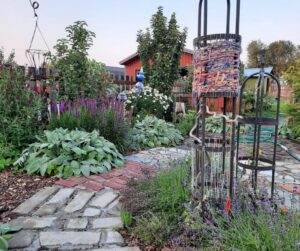
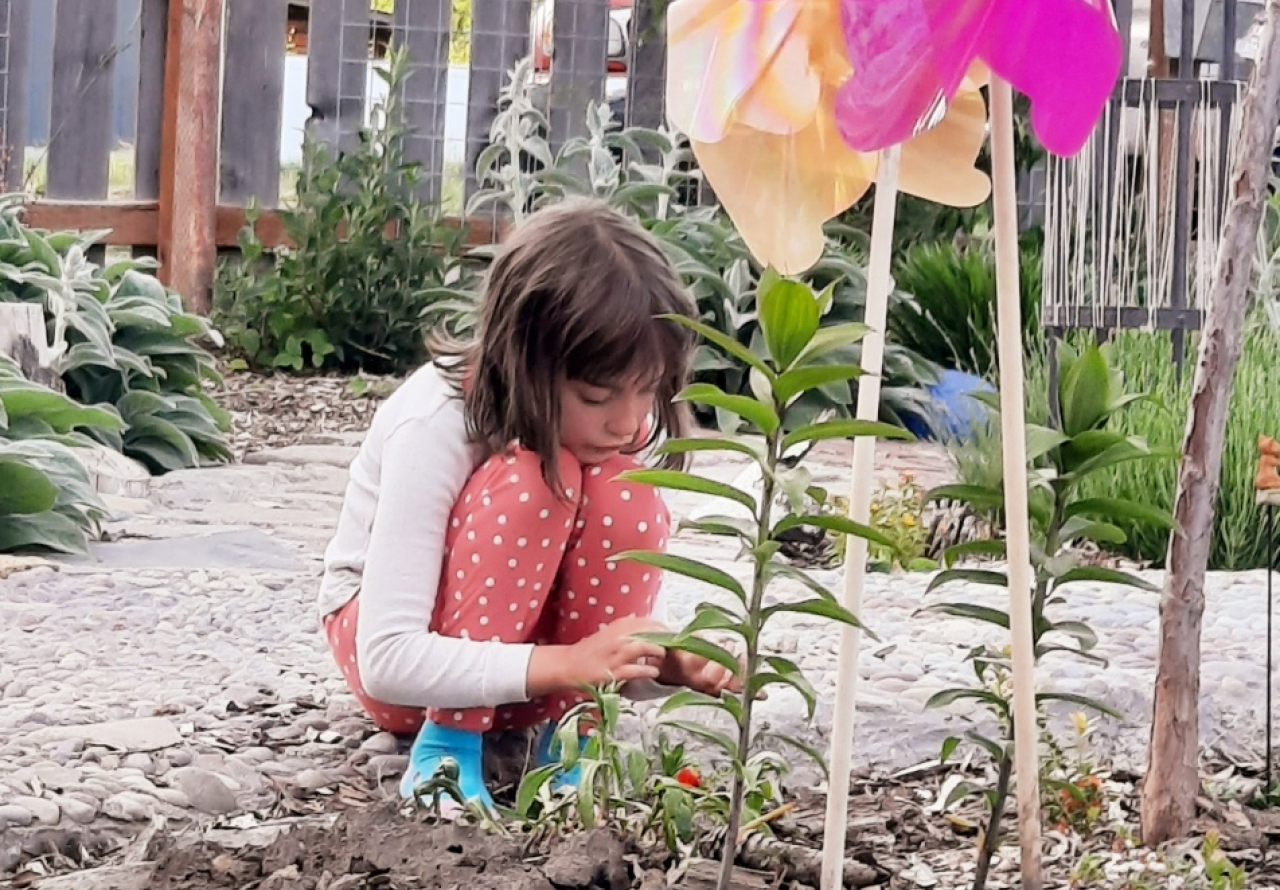
This garden offers high visual stimulation through variety of color, texture, form, pattern and other features.
They’re a feast for the eyes!
Sight is the way many of us interpret our world.
Through sight, we come to understand the place in which we live. We develop an interpretation and understanding of its characteristics, its visual properties.
We see and connect with our loved ones and with ourselves.
Children’s vision rapidly developed from birth until the age of 3. In that time, they become aware of, identify, and interpret things like shapes, colors, distance, and depth.
Children also build their vocabulary and social skills by naming and describing what they see. At the same time, they’re connecting with others AND with the natural world.
Nature itself offers seemingly infinite variety for us to observe and interact with through our sight. The patterns and colors of butterfly wings. Puffy, round dandelion seedheads. Light refracting off a pool of water. Dark spores on the underside of a fern leaf. Rainbows.
It would take me more than a lifetime to list all of nature’s incredible sights.
The more nature in a play space, the more variety of high-quality visual stimulation is present. Log rounds, chunky bark pieces, boulders, seed pods, flowers, grass stalks, water, sand, plants, and trees…again, the list is very, very long.
In a playscape, we can complement the natural world by incorporating different man-made shapes, forms, patterns, textures, and colors. We can provide additional visual elements to further capture children’s attention, inspire their imagination, and beg for interaction.
Some ideas for adding visually stimulating sensory features include a sculptural garden arbor with climbing vines, kinetic features like wind spinners, garden art and sculpture, colorful plantings, outdoor murals, and tools like a magnifying glass or magnifying station, kaleidoscope, or telescope.
How you create visual interest and experience is only limited by your imagination.
Nature offers the best kind of sensory stimulation! When plants are added to a children’s play area, the space literally comes alive.
Sensory plants are those that have particular qualities that engage our senses in different ways.
We’re talking about the sense of sight this week. Plants have different sizes, shapes, colors, and visual textures. Depending on how you use them, they can excite or soothe.
Rousing warm colors (red, orange, yellow) ‘advance’ visually, whereas calming cool colors (greens, blues, purples) tend to recede visually.
Massing plants, or planting them in greater quantities, gives a visual punch and draws the eye.
Plants with interesting forms are columnar, weeping, and twisted. You might use these plants as focal points or landmarks in the playscape.
Some plants and trees have interesting bark texture that invites a child’s touch. Add these where children can easily access them, like near a cozy space or along a path.
And, flowers, ooooooh the flowers. They come in infinite expressions of beauty. Kids love picking bouquets of blooms just to feel connected with nature’s dazzling drama.
Here’s a small sampling of plants that delight children’s sense of sight:
Paperbark maple, Acer griseum, hardiness zones 5-8
I have one of these small trees in our sensory garden. It’s greatest sensory trait is its flaking, curling cinnamon colored bark.
Approx. 25’ tall x 15’-20’ wide
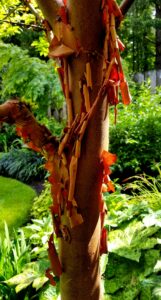
Paperbark Maple Photo credit: the beautiful Vickie Devlaeminck
Harry Lauder’s Walking Stick, Corylus avellana ‘Contorta’, hardiness zones 3-9
With its gnarled, twisted branches, this small tree looks like it came straight out of a Tim Burton film!
8’ – 10’ tall and wide
Magical Gold Forsythia, Forsythia x intermedia ‘Kolgold’, hardiness zones 5-8
As winter makes way to spring, forsythia’s blooms are like radiant sunshine. This early bloomer brings cheer to any early garden. The flowers are also edible and can be used salads or made into jelly, syrup, and tea!
4’ – 5’ tall and wide
Dark Horse Weigela, Weigela florida ‘Dark Horse’, hardiness zones 4-8
This weigela (pronounced vie-gela) has dark purple-bronze foliage, which makes a beautiful statement itself, and is especially dramatic when paired with chartreuse- or blue-colored foliage plants. It has a long bloom season with its trumpet-shaped magenta flowers.
3’ tall and wide
Fanfare Blanketflower, Gaillardia x grandiflora ‘Fanfare’, hardiness zones 3 – 10
This is a plant that will excite your little ones with its incredible yellow, orange and red blooms. This blanketflower has unique petals, so plant it where children can inspect it, in a fairy garden, along a pathway, or nearby a sitting area.
12” high x 18” wide
Gladiator Allium, Allium ‘Gladiator’, hardiness zones 4 – 10
There are many choices of allium, but the one that makes the biggest statement is Gladiator. This bulb sends up a globe shaped flower that is like an exclamation point in the garden! Plant in clusters of 5 or more to make a real statement.
36” - 60” tall
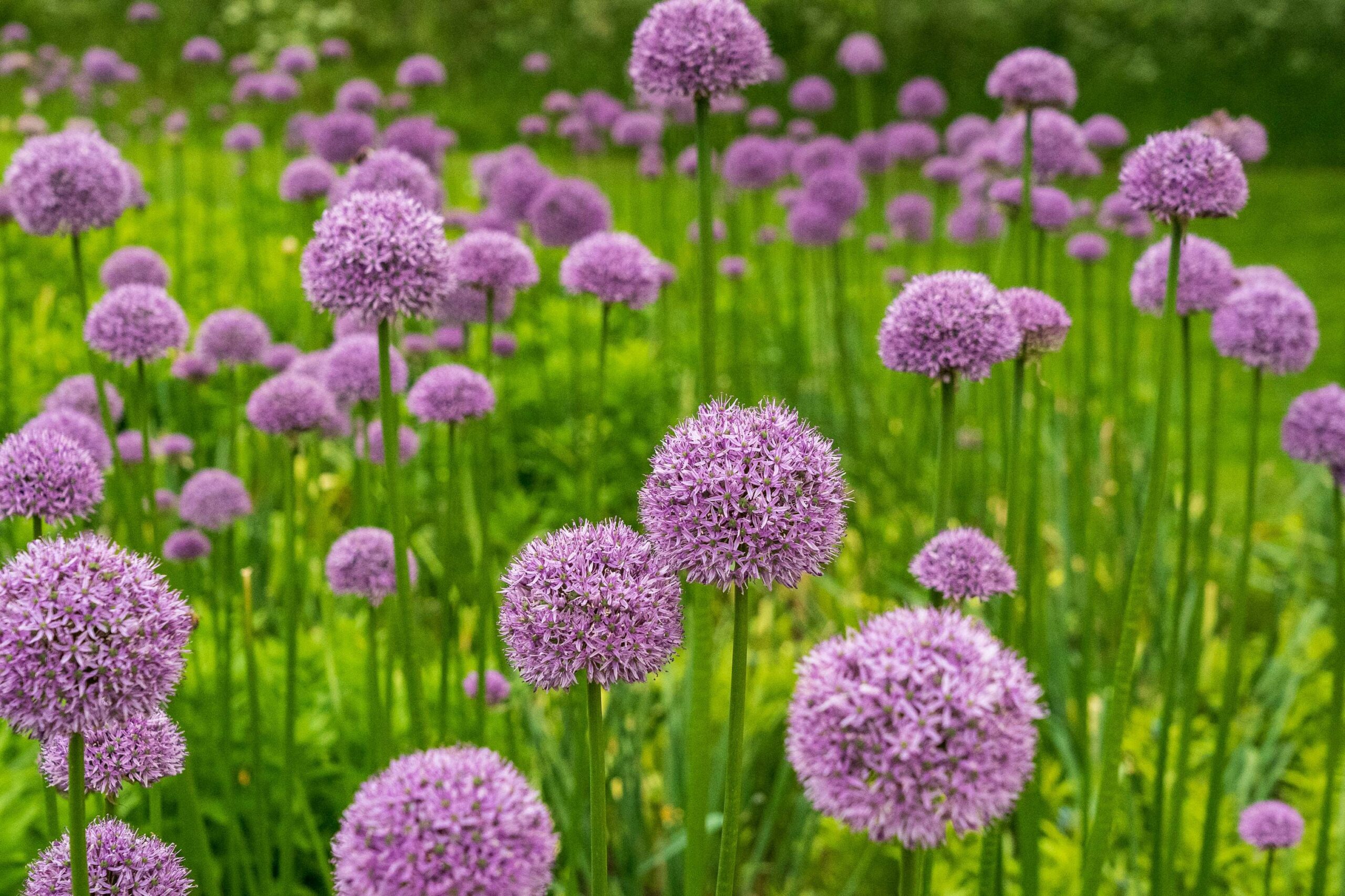
Allium Credit: Nick Fewings, Unsplash.
Purple Passionflower, Passiflora incarnata, hardiness zones 6 – 11
What can I say, there aren’t many blooms that rival the detail and uniqueness of a passionflower. This climbing vine is perfect for arbors, tunnels, and cozy spaces. Plant this where children have a chance to sit quietly and inspect this floral masterpiece.
12’ – 25’ long
Sunflower, Helianthus species, hardiness zones 4 - 9
To me, sunflowers are the “children” of the plant world. They’re full of life, innocence, sunshine, and cheer. My favorite uses of sunflowers are ‘sunflower houses’. Plant sunflower seeds in a circle, approximately 5’ – 6’ diameter. As they grow, they can be guided to arch together to form a vegetative hut (cozy space).
Heights vary
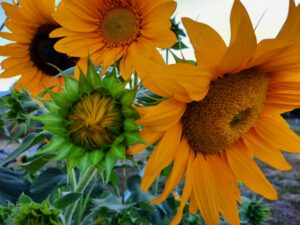
Sunflower
As always, be sure that all plants in the play area are non-toxic (there are a lot of online resources available to confirm a plant’s nontoxicity).
Also, pesticides, herbicides, and other harmful chemicals should NEVER be used in play areas. Children, especially those experiencing neurodiversities, are more vulnerable to the harmful effects of environmental toxins than adults.
Now that you have some ideas for enhancing the visual interest of your kids’ play and learning space it’s time to take action. Pick one thing that you know your kids would love. Better yet, have them pick one thing! Make it a fun family project and you’ll all benefit.
Wishing you the very best in creating a beautiful play and learning space for your kiddo!
Check out my eBook, Nature Play for the 7 Senses: A Parent’s Guide for Natural Play & Learning Spaces for ALL Children
Our sensory systems are the filters through which we understand our world. As children, it is the ‘language’ we use to speak with our environment.
Something interesting happens when a child enters an environment, whether it's a park playground, an outdoor classroom, a streetscape, or even their own bedroom.
A child initiates an unspoken conversation with their environment, and it goes something like this...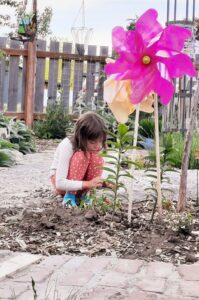
A child asks <hey, environment> “what can you offer me?” “What can I experience here?” “How can I play and spark my imagination?” “How will I know I’m safe?” “What can I learn from you?” “How may I grow here?”
And, the internal questioning continues...
The environment responds to the child, always. It responds to them in a language they can easily understand: through their senses. The natural environment is rich in color, shape, texture, fragrance, sensation, taste, movement, and on and on. The conversation begins as the child starts playing, and the dialogue becomes more rich and deep as they explore, discover, and develop a relationship with the space.
This loving, nurturing silent conversation happens between nature and children of any ages, even infants. This beautiful dialogue takes place between nature and children who are non-verbal. Nature is always speaking to us. We have to still ourselves to listen.
And, we must allow our children time and place to still themselves as often as possible because, for them, these conversations quickly develop into a relationship with nature that lasts their entire lives. A relationship that anchors them, especially when their lives can get turbulent.
This is one of the many reasons I advocate for nature play.
Nature play is one of the best tools we have to give our children what they need to develop into the amazing humans they're meant to be.