There’s a scene from my favorite movie, Amelie, where she’s standing in a quaint little French street in front of a grocer. She pauses beside the produce stand and when no one’s paying any attention, she slowly sinks her hand into a bag of lentils. She closes her eyes as an expression of peace and delight washes over her face. In the midst of the streetscape bustle Amelie experiences calm and a temporary escape through this simple, tactile act.
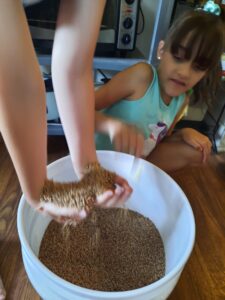
Just like Amelie, my girls are enjoying the feeling and pressure of swirling their hands and arms in a bucket of grain.
As far as the senses go, touch is fundamental to understanding our surroundings and the activities of everyday life. Our largest organ, our skin, is responsible for much of our tactile experiences. Our skin is constantly receiving messages about our environment and communicating those messages to our brain to interpret the experience…and how we need to react to that experience. We’re alerted to danger (when our hand touches a hot stove burner, we quickly pull our hand away!). We feel comfort, calm, and safety (curled on the couch wrapped in a warm, fuzzy blanket…all is well and I can rest).
The greater the variety of tactile experience during childhood, the greater the understanding the child will develop about their environment and more successfully they navigate that environment. Exploring touch is essential for all children, especially those with visual impairments. Whether you have a big yard or a modest apartment balcony, you can easily maximize the tactile quality of your space for your kiddos. How do you do that? Look around you right now. What do you see in various textures? Where and how do you experience warmth, coolness, cold? To add more tactile interest, think temperature and texture. How many ways can kids explore tactile qualities like:
Soft . Fuzzy . Smooth . Hard . Bumpy .
Prickly . Warm . Cool . Cold . Icy .
What else??
If you have kiddos that are hypersensitive or hyposensitive to touch, a space filled with a variety of textures and temperatures will help them explore this sensory system on their own terms and at their own pace which will help bring them self-regulate their nervous system.

Make an easy nature loom out of a garden obelisk, trellis, or fencing.
Give them what they love! Be sure to include lots and lots of the textures they love so their time is as joy-filled as possible. Here are some ideas for adding tactile interest to their play and learning space:
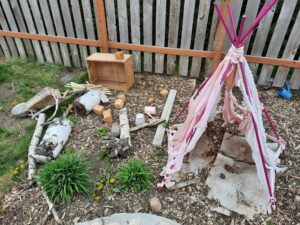
A loose parts play area can look messy at times but that’s ok. The sensory value is off the charts amazing!
Nature is always inviting children to play and connect. Children always want to be hands-on in that experience.
Sensory plants that invite touch are incredible assets in a nature play space. Consider them ambassadors for co-creating children’s nature appreciation and connection.
Through touch, children get to know each plant intimately, and through that process become part of the magic and awe of nature.
Let me say it directly: Children come to know they’re part of nature.
When we slow down and pay attention we really notice the incredible variety of textural interests in the plants and trees around us: the bark, branches, leaves, cones, flowers, seed heads, and pods.
It’s pretty mind boggling.
So, how can you use plants to boost the play and learning value?
Can you use plants to create textural contrast? How about planting purple coneflower next to lamb’s ears? Running your fingers over the spiny seedheads of coneflower are a distinctly different experience than stroking the fleecy, fuzzy leaves of lamb’s ears. There are so many ways to mix-and-match plant textures.
How can tactile plants be used in play activities? Natural loose parts play is a great place to start. I have another post about the play value of loose parts.
Lastly, tactile plants are very effective when planted where children spend lengths of time in an activity, like a sand play area, cozy space, or fairy garden. Plants within arms reach will be reached for, again and again.
Some of my favorite plants for tactile interest include:
Big Ears Lambs Ears, Stachys byzantina ‘Big Ears’, hardiness zones 4-9
This perennial tops my list of tactile favorites! The leaves of lambs ears feels just as soft and fleecy as the name sounds. I much prefer the Big Ears variety (also called Helen von Stein) as it doesn’t spread as enthusiastically as other varieties. This plant is a tagless cotton shirt, if you catch my drift. If you have a kiddo who’s touch averse, this plant offers great potential for exploring that comfort zone.
Approx. 12” tall x 24” wide and spreading
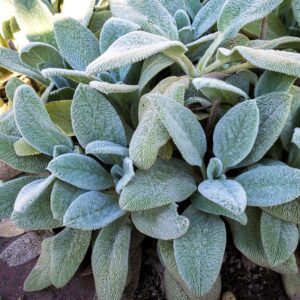
Big Ears Lambs Ears is my all-time fave tactile perennial.
Kim’s Knee High Coneflower, Echinacea purpurea ‘Kim’s Knee High’, hardiness zones 3-8
Coneflowers have a spiny seedhead that it’s really interesting to touch. Don’t prune off the seedheads in the fall. Leave them over the winter for loose parts play and food for birds.
18” tall and wide
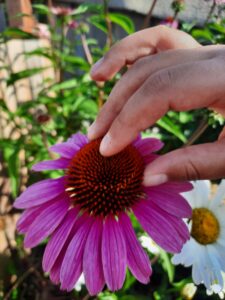
Kim’s Knee High and other coneflower varieties have an interesting seedhead and the pollinators love them!
Woolly Thyme, Thymus pseudolanuginosus, hardiness zones 4-7
Kids can walk barefoot on woolly thyme. As winter makes way to spring, forsythia’s blooms are like radiant sunshine. This early bloomer brings cheer to any early garden. The flowers are also edible and can be used salads or made into jelly, syrup, and tea!
4”-6” tall x 12” wide
Purple Emperor Sedum, Sedum x ‘Purple Emperor’, hardiness zones 3-9
This full sun, drought tolerant perennial is a great tactile plant for its succulent, spongy leaves and its fluffy summertime flower heads. Keep the flower heads on through the winter for four seasons of play value.
12” tall x 18” wide
Little Bunny Dwarf Fountain Grass, Pennisetum alopecuroides ‘Little Bunny’, hardiness zones 4-9
Fountain grass comes in all sizes and Little Bunny is the smallest of them all. This ornamental grass is as cute as its name sounds and makes a special statement in a children’s play spaces with its fine-textured grass blades and super soft seedheads.
12” tall and wide
As always, two friendly reminders: 1) be sure that all plants in the play area are non-toxic, and 2) pesticides, herbicides, and other harmful chemicals should NEVER be used in play areas.
Check out my eBook, Nature Play for the 7 Senses: A Parent’s Guide for Natural PLay & Learning Spaces for ALL Children
Visualize brown, papery pinecones; spring daffodils nodding their yellow heads in the breeze; grey, armored roly poly bugs; delicate ethereal spider webs sparking with morning dew; and bright red maple leaves that flutter to the ground in the fall.
Can you picture cheerful wind spinners making a breeze visible; homemade, hand painted birdhouses; colorful flowers in your grandmother’s garden, and a cheeky little gnome statue peeking out from behind a moss-covered log…what do all these things have in common?
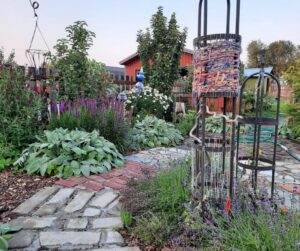
This garden offers high visual stimulation through variety of color, texture, form, pattern and other features.
They’re a feast for the eyes!
Sight is the way many of us interpret our world.
Through sight, we come to understand the place in which we live. We develop an interpretation and understanding of its characteristics, its visual properties.
We see and connect with our loved ones and with ourselves.
Children’s vision rapidly developed from birth until the age of 3. In that time, they become aware of, identify, and interpret things like shapes, colors, distance, and depth.
Children also build their vocabulary and social skills by naming and describing what they see. At the same time, they’re connecting with others AND with the natural world.
Nature itself offers seemingly infinite variety for us to observe and interact with through our sight. The patterns and colors of butterfly wings. Puffy, round dandelion seedheads. Light refracting off a pool of water. Dark spores on the underside of a fern leaf. Rainbows.
It would take me more than a lifetime to list all of nature’s incredible sights.
The more nature in a play space, the more variety of high-quality visual stimulation is present. Log rounds, chunky bark pieces, boulders, seed pods, flowers, grass stalks, water, sand, plants, and trees…again, the list is very, very long.
In a playscape, we can complement the natural world by incorporating different man-made shapes, forms, patterns, textures, and colors. We can provide additional visual elements to further capture children’s attention, inspire their imagination, and beg for interaction.
Some ideas for adding visually stimulating sensory features include a sculptural garden arbor with climbing vines, kinetic features like wind spinners, garden art and sculpture, colorful plantings, outdoor murals, and tools like a magnifying glass or magnifying station, kaleidoscope, or telescope.
How you create visual interest and experience is only limited by your imagination.
Nature offers the best kind of sensory stimulation! When plants are added to a children’s play area, the space literally comes alive.
Sensory plants are those that have particular qualities that engage our senses in different ways.
We’re talking about the sense of sight this week. Plants have different sizes, shapes, colors, and visual textures. Depending on how you use them, they can excite or soothe.
Rousing warm colors (red, orange, yellow) ‘advance’ visually, whereas calming cool colors (greens, blues, purples) tend to recede visually.
Massing plants, or planting them in greater quantities, gives a visual punch and draws the eye.
Plants with interesting forms are columnar, weeping, and twisted. You might use these plants as focal points or landmarks in the playscape.
Some plants and trees have interesting bark texture that invites a child’s touch. Add these where children can easily access them, like near a cozy space or along a path.
And, flowers, ooooooh the flowers. They come in infinite expressions of beauty. Kids love picking bouquets of blooms just to feel connected with nature’s dazzling drama.
Here’s a small sampling of plants that delight children’s sense of sight:
Paperbark maple, Acer griseum, hardiness zones 5-8
I have one of these small trees in our sensory garden. It’s greatest sensory trait is its flaking, curling cinnamon colored bark.
Approx. 25’ tall x 15’-20’ wide
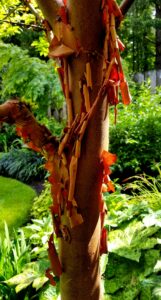
Paperbark Maple Photo credit: the beautiful Vickie Devlaeminck
Harry Lauder’s Walking Stick, Corylus avellana ‘Contorta’, hardiness zones 3-9
With its gnarled, twisted branches, this small tree looks like it came straight out of a Tim Burton film!
8’ – 10’ tall and wide
Magical Gold Forsythia, Forsythia x intermedia ‘Kolgold’, hardiness zones 5-8
As winter makes way to spring, forsythia’s blooms are like radiant sunshine. This early bloomer brings cheer to any early garden. The flowers are also edible and can be used salads or made into jelly, syrup, and tea!
4’ – 5’ tall and wide
Dark Horse Weigela, Weigela florida ‘Dark Horse’, hardiness zones 4-8
This weigela (pronounced vie-gela) has dark purple-bronze foliage, which makes a beautiful statement itself, and is especially dramatic when paired with chartreuse- or blue-colored foliage plants. It has a long bloom season with its trumpet-shaped magenta flowers.
3’ tall and wide
Fanfare Blanketflower, Gaillardia x grandiflora ‘Fanfare’, hardiness zones 3 – 10
This is a plant that will excite your little ones with its incredible yellow, orange and red blooms. This blanketflower has unique petals, so plant it where children can inspect it, in a fairy garden, along a pathway, or nearby a sitting area.
12” high x 18” wide
Gladiator Allium, Allium ‘Gladiator’, hardiness zones 4 – 10
There are many choices of allium, but the one that makes the biggest statement is Gladiator. This bulb sends up a globe shaped flower that is like an exclamation point in the garden! Plant in clusters of 5 or more to make a real statement.
36” - 60” tall
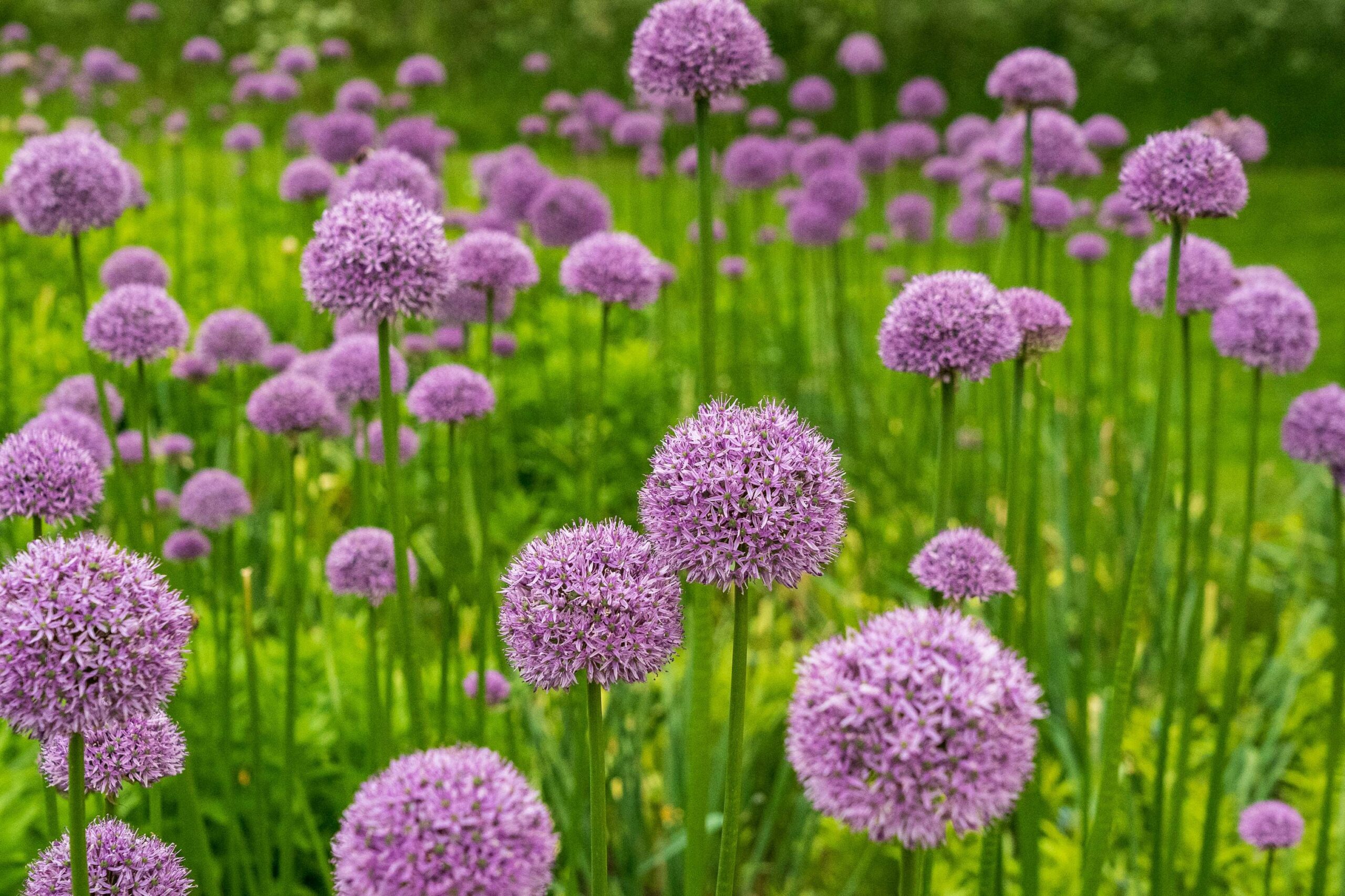
Allium Credit: Nick Fewings, Unsplash.
Purple Passionflower, Passiflora incarnata, hardiness zones 6 – 11
What can I say, there aren’t many blooms that rival the detail and uniqueness of a passionflower. This climbing vine is perfect for arbors, tunnels, and cozy spaces. Plant this where children have a chance to sit quietly and inspect this floral masterpiece.
12’ – 25’ long
Sunflower, Helianthus species, hardiness zones 4 - 9
To me, sunflowers are the “children” of the plant world. They’re full of life, innocence, sunshine, and cheer. My favorite uses of sunflowers are ‘sunflower houses’. Plant sunflower seeds in a circle, approximately 5’ – 6’ diameter. As they grow, they can be guided to arch together to form a vegetative hut (cozy space).
Heights vary
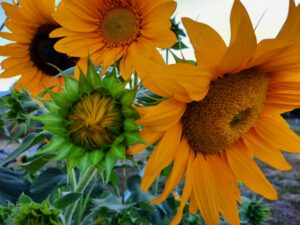
Sunflower
As always, be sure that all plants in the play area are non-toxic (there are a lot of online resources available to confirm a plant’s nontoxicity).
Also, pesticides, herbicides, and other harmful chemicals should NEVER be used in play areas. Children, especially those experiencing neurodiversities, are more vulnerable to the harmful effects of environmental toxins than adults.
Now that you have some ideas for enhancing the visual interest of your kids’ play and learning space it’s time to take action. Pick one thing that you know your kids would love. Better yet, have them pick one thing! Make it a fun family project and you’ll all benefit.
Wishing you the very best in creating a beautiful play and learning space for your kiddo!
Check out my eBook, Nature Play for the 7 Senses: A Parent’s Guide for Natural Play & Learning Spaces for ALL Children
Our sensory systems are the filters through which we understand our world. As children, it is the ‘language’ we use to speak with our environment.
Something interesting happens when a child enters an environment, whether it's a park playground, an outdoor classroom, a streetscape, or even their own bedroom.
A child initiates an unspoken conversation with their environment, and it goes something like this...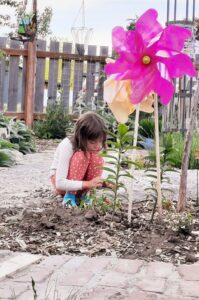
A child asks <hey, environment> “what can you offer me?” “What can I experience here?” “How can I play and spark my imagination?” “How will I know I’m safe?” “What can I learn from you?” “How may I grow here?”
And, the internal questioning continues...
The environment responds to the child, always. It responds to them in a language they can easily understand: through their senses. The natural environment is rich in color, shape, texture, fragrance, sensation, taste, movement, and on and on. The conversation begins as the child starts playing, and the dialogue becomes more rich and deep as they explore, discover, and develop a relationship with the space.
This loving, nurturing silent conversation happens between nature and children of any ages, even infants. This beautiful dialogue takes place between nature and children who are non-verbal. Nature is always speaking to us. We have to still ourselves to listen.
And, we must allow our children time and place to still themselves as often as possible because, for them, these conversations quickly develop into a relationship with nature that lasts their entire lives. A relationship that anchors them, especially when their lives can get turbulent.
This is one of the many reasons I advocate for nature play.
Nature play is one of the best tools we have to give our children what they need to develop into the amazing humans they're meant to be.
I’d like to start this post with a story, one of the most moving stories I’ve heard about how nature can reach a child through their sensory experience, connecting with the deepest part of them. This story is a recap of a conversation I had with a former Director of a small, rural nature center in the Midwest.
The nature center was a frequent destination for elementary school field trips. That day a school bus loaded with 5th graders came to the center for a ½ day visit. Not that long after they arrived, the Director, looking for the teacher, walked through the group of children who were immersed in their natural learning activities with staff. She spotted the teacher standing away from the group, crying.
Immediately she went over and asked the teacher if she was ok and if everything was alright. The teacher responded by saying, “Everything’s amazing.” She went on to tell the Director that she had just been approached by one of her students, a boy with autism. This boy had been nonverbal since birth. Within 20 minutes of being at the nature center, he came to her a said, “This place is SO beautiful and the air smells so GOOD.”
Dang it. I get overcome with emotion every time I think about this story. We don’t fully understand the depth of what nature gives us. We may never truly understand how nature opened a door for this child that allowed him to speak for the first time in his life, a full sentence no less. The words were always there inside him. Nature helped him let it out. More specifically, I’ll wager, his sensory experience of nature helped him let it out.
We all perceive the world through our senses. Our sensory system receives information <Whoa, that’s hot. I’m standing too close to the campfire!” Or, “Something smells good…Woo hoo, mom made cinnamon rolls!> Our senses work together seamlessly communicating information to our brain helping us make sense of our world.
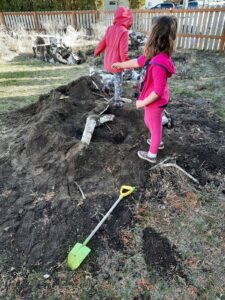
Digging in the dirt is a multi-sensory experience, especially when there's tools, loose parts, and friends involved!
All children need experiential, nature-based sensory play. Our sensory systems (and neurological system and brain...) only develop when they’re stimulated. There’s tons of research to back up what I’m saying here: the more sensory-rich a child’s daily environment, the greater the development of their sensory system, their brain, their motor skill development, their imagination, and other beautiful things.
Most of the magic happens from birth to the age of 10, when a child’s systems are developing, flexible, and trying to soak up all the sensory information they can. Being immersed in a sensory-rich environment is good for all of us. Developmentally, children MUST be immersed in constant, varied sensory experiences so they can develop in the way they were meant to.
And, it’s simple. A sensory-rich environment is a nature-rich environment.
Now, we don’t all experience the world in the same way, therefore we don’t all understand the world in the same way. Children and people with autism experience the world very differently, in large part, because their sensory system processes information very differently. For someone without autism or sensory processing disorder (SPD), toe seams in socks may be unnoticeable. For some with autism or SPD, toe seams may be so irritating that they can’t concentrate on learning. A fire truck siren may hurt our ears temporarily, but for a child with autism or SPD hearing a blaring siren may cause severe physical pain.
Additionally, kids with autism and sensory processing disorder may be hypersensitive or hyposensitive in one or more of their senses. A child who’s hypersensitive is getting too much information from the world around them (system overload). One who’s hyposensitive is not getting enough information (system underwhelm). Either way, this sensory imbalance forces children to seek activities and spaces that help bring them into sensory balance. Often their sensory experiences and sensitivities cause them discomfort, confusion, frustration, and sometimes even pain.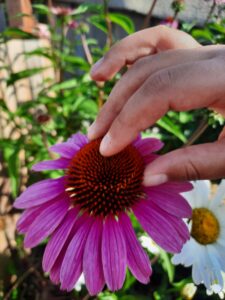
The most important thing I realized, in 20+ years of designing outdoor spaces for children, is that good design for children with autism is good design for ALL children. And, that is the foundation from which I design and advocate.
So, how can we create nature play spaces at home that stimulate children's sensory systems, and by extension, their bodies, brains, imaginations, hearts, and spirits?
There are 7 sensory systems that gather information
We all know the 5 senses: touch, sight, taste, small, and sound.
But, there are 2 sensory systems that are underrepresented, yet critical to understanding child development and growth: the vestibular system and the proprioceptive system, or proprioception.
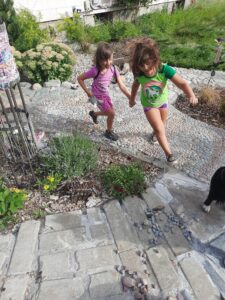
Running and walking are vestibular activities.
The vestibular system is located in our inner ear. If you’ve ever experienced vertigo, that’s your vestibular system gone haywire. This system responds to the position of the head in relation to gravity and accelerated or decelerated movement <Am I upside down? Am I right side up? Am I sideways?> Swinging and spinning are vestibular activities.
Proprioception is the sense of your own body in space, without the use of other senses such as sight or touch. <I can walk past this table without bumping into it.> It’s also knowing where your limbs are relative to each other. <Can you close your eyes and touch your nose?> It’s how your body communicates with your joints, tendons, and muscles. <My brain knows how much force my hand and fingers need in order to pick up a paper cup full of water without splooshing it all over the place.> Issues in proprioception revolve around motor coordination, body awareness, and balance.
Once you start looking at play and learning activities from the perspective of sensory experiences, you'll gain a whole new appreciation for simple activities like playing in the sand, exploring the local creek, and walking barefoot in the grass.
Check out my other posts that go in-depth on each sensory system, and which nature play features and activities are the best for each one.
Check out my eBook, Nature Play for the 7 Senses: A Parent’s Guide for Natural PLay & Learning Spaces for ALL Children
Thanks so much for being here with me! Whether you’re new to the nature play scene or a seasoned expert, I’m certain you’re going to find here a fresh perspective and heart-felt information on this very important thing we call nature play.
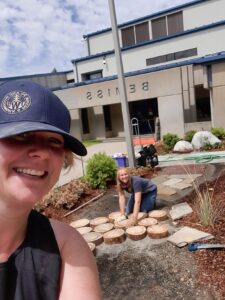
Leading a sensory path installation with some amazing school volunteers!
Let me introduce myself, I’m Jena. I’m a landscape architect with 20+ years’ experience designing nature-based play, learning, and therapeutic landscapes for kiddos of all abilities and diversities.
Now, I teach parents, educators, therapeutic professionals, and others how to create sensory-rich play spaces at home or wherever their kids are. I do this because I believe the power should also be in your hands to create loving, engaging, natural play/learning/therapeutic spaces where your kids will blossom.
My approach to my work centers on creating environments that engage children’s 7 sensory systems: sight, touch, taste, smell, sound, vestibular, and proprioception.
Why is this important, you ask? It is not just important, I say, but essential. I’m going to share the 3 biggest reasons why I have an unshakeable belief in the value of sensory-rich nature play:
Essential reason #1...
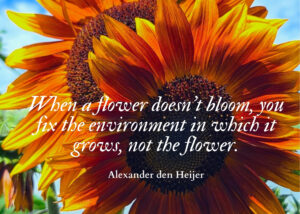
Our children are as beautiful and diverse in their being, individuality, learning, cognition, and physicality, as the flowers in a well-tended garden. And, that’s how it should be.
When we garden, we recognize that each individual plant has its own set of care needs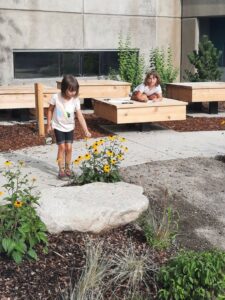 and conditions in which it thrives. It’s the same with our children. Each child has his or her own set of care needs and conditions so they may grow into the fullest, happiest, most centered versions of themselves possible.
A child develops, learns, plays, and thrives when their sensory systems are given rich, diverse, high-quality sensory information.
The goal of a sensory-rich nature play area is to provide a diverse range and depth of sensory experiences where a child can seek out the type and intensity of sensory input that feels best to them at the time. The ability for kids to choose their experiences is ESSENTIAL, as I said before, because what one child needs to thrive can be very different from another’s (and that’s perfect).
These spaces are inclusive by providing equitable play and learning experiences. For example, there’s more than one way to learn one’s alphabet: pencil and paper, drawing with a stick or their finger in the sand, creating letters out of bits of natural materials…and it’s not always done sitting down. Kids, if they’re inspired, can move their bodies, lay on their bellies, or whatever position feels best for them. Sayonara, tiny uncomfortable school chair.
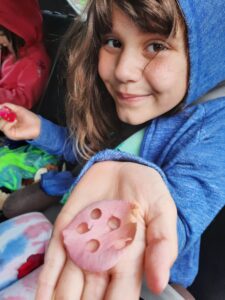
With diversity of natural features and activities, all kids will find valuable experiences for their bodies, minds, and spirits.
Nature play areas are also inclusive because nature doesn’t judge. Nature will meet any child right where they are physically, cognitively, emotionally, and socially. Nature is the most loving, supportive, and sometimes challenging (in a good way) companion for kids of all abilities and diversities.
Essential reason #2 is...
The healing benefits of nature has been well-researched over decades. I’m glad for the scientific ‘proof’. But, I’ve even more glad that we have the ability to look into our hearts to understand nature’s healing power with even more clarity and truth. For all ages, natural environments boost our happiness and joy, our immune systems, our self-confidence, and so much more. Kids, specifically, benefit from nature’s ability to help them with sensory balance, lessening the symptoms of many conditions like autism, sensory-processing disorders, and ADHD (yes, there are lots of studies on this).
Children’s landscapes, like nature play areas, learning environments, and sensory gardens aren’t just healing for the kids; these spaces are healing for us all. I speak to this on a global stage on a professional level and I also have personal experience.
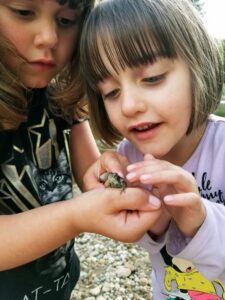
The twinners find a tiny frog at our favorite creek spot.
In 2012 I dealt with cancer and multiple emergency surgeries that almost ended me. It took a long time for my body and mind to come back to some degree of ‘health’. In 2015, I gave birth to an amazing set of twins, whom I love more than life itself. After 2 1/2 years of minimal sleep (I’m talking an average of 3 hours a night) I’m back to being a ragged zombie with no time or energy to attend to my own physical or mental health. What mom can’t relate, right?
In 2018, I decided to build a children’s sensory garden at our home. Over the past few years, the garden has grown and evolved into a magical space that we all enjoy beyond measure. I built it with my own two hands, with much supervision and guidance from my girls. Our garden has, for me, offered daily opportunities for physical healing, mental clarity, emotional support, and a feeling of wholeness and connection.
My point, dear moms and dads, is that if you build a nature play space at home, it will benefit, holistically, the health of your children, you…your entire family.
And, the third essential reason is…
If you ask me, a primary purpose of childhood is discovering all the experiences that bring us joy.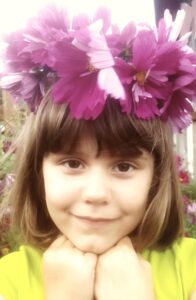
In joy, there’s innocence.
In joy, there’s connection.
In joy, we figure out who we really are.
In joy, we are all in our native state.
Children naturally seek that state of joy in every moment of their waking lives. They embody that innocent, vibrant energy. They relish the feelings of connectedness. They intuitively understand that this state of being is closer to their authentic selves.
We seem to lose this ability as we go into later school years and as we become adults. Then, we spend our adult lives being productive, and efficient, and pushing ourselves harder and harder. I, myself, have always been a hard worker and have spent many years in the mindset that the harder I work, the faster I’ll get to where I want to be. But, in the process, I lost much of the joy in life that makes each day magical. AND, where I wanted to be always seemed to shift around, a constantly moving target. Even now, I look around and see most of my family, friends, and colleagues clinging tight to that same belief. I have to ask, ‘Where is that really getting us?’
I truly believe that children are our teachers, and we can find no better. They remind us what’s really important. They encourage us to break out of our ‘programming’ and look at the world with fresh eyes. They give us permission to do things differently than how everyone else does it. They want us, need us, to unabashedly be our unique selves. That way, they have the freedom to do the same.
Children remind us to find the joy in all the small moments. That’s the only place joy truly exists, and they know it.
Check out my eBook, Nature Play for the 7 Senses: A Parent’s Guide for Natural PLay & Learning Spaces for ALL Children
American novelist Henry Miller once said, “The moment one gives close attention to any thing, even a blade of grass, it becomes a mysterious, awesome, indescribably magnificent world in itself.”
Moments like this make me appreciate Miller’s sentiment.
One early summer day not too long ago, my girls and I were out in the sensory garden picking raspberries (we were going to make freezer jam). One daughter, who has a beautiful, well-tended gift for distraction, noticed that there were more ladybugs than usual out. Commenting that there are a handful of ladybugs on the Autumn Joy sedum plants nearby, she went in for closer inspection.
My other daughter and I decided that what she was doing was a heck of a lot more fun that what we were doing so we joined in on the discoveries. We found several different kinds of flies hanging out on the unopened flower buds. We discovered a spider who had created her egg nest on the cupped underside of a leaf. Then, we found the most magical thing of all!
We noticed dried slug slime trails running up the stem and leaves and going all the way up and across the fanned out flower heads! It looked like "magical rainbow tape", as one of them described it.
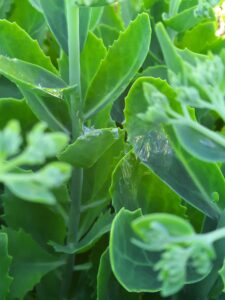
Look closely and you’ll see the magical rainbow tape!
The dried slug trail was paper thin and fragile. We gently poked it and it broke. It was clear with an iridescent, rainbow sheen. I despise finding slugs in the garden, but that morning they left us something that sparked my 7-year old twins’ imaginations.
Their favorite hypothesis about the magical rainbow tape was that it was a gift from the slugs to the ladybugs. Ladybugs are small and it takes a long time for them to get from one sedum stem to another. They’d have to travel all the way down, over to the next stem, and then all the way up. Exhausting!
The slugs, apparently kind and generous by nature, wanted to leave the ladybugs bridges between the stems to make their travels more convenient. They have really tiny legs, after all.
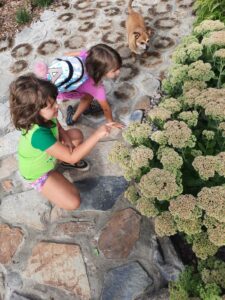
Children’s connection with nature is indescribably beautiful and essential!
Here, in one unassuming sedum plant, we found the multiple, indescribably magnificent worlds, each with their own rich story.
Here, I witnessed the beating heart of nature connecting with the open hearts of my children. There is magic all around us, all the time. Often, it takes our children to point out the obvious for us. Thank goodness they do.
Sensory plant feature: Autumn Joy Sedum, Sedum spectabile ‘Autumn Joy’, hardiness zones 4 – 11, grows to approx. 24” tall and slightly wider. Truly a 4-season perennial!
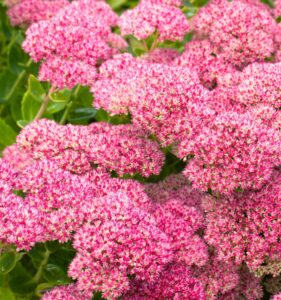
Autumn Joy sedum in bloom!
Check out my eBook, Nature Play for the 7 Senses: A Parent’s Guide for Natural PLay & Learning Spaces for ALL Children